Pumping schedule planner
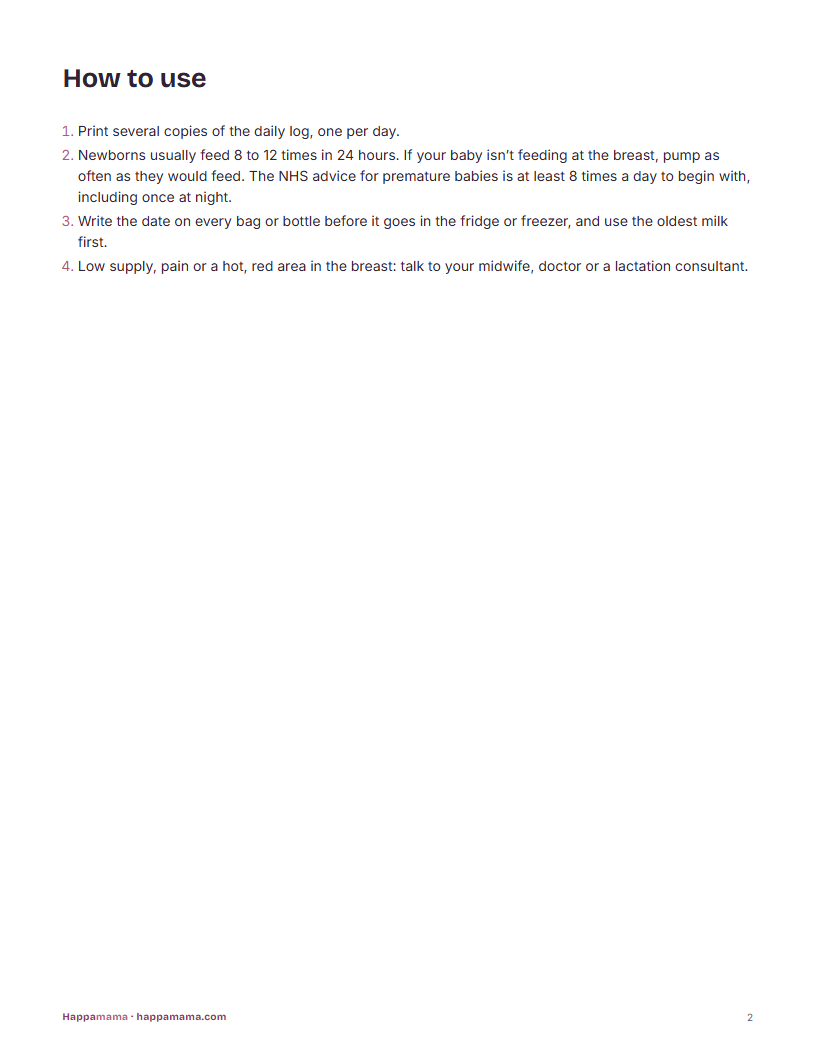
If your baby isn’t feeding at the breast, pump as often as they would feed. For a newborn that is 8 to 12 times in 24 hours. The NHS advice for premature babies is at least 8 times a day to begin with, including once at night. This planner spreads your sessions across the day.
A session usually takes about 10 to 15 minutes once you’re used to your pump (OWH). If you’re trying to raise supply, the AAP suggests pumping more often for at least 10 minutes.
The US Office on Women’s Health says you may need to pump 2 to 3 times a workday, at the times you’d feed your baby. Under the US PUMP Act you get break time each time you need to pump for one year after birth, in a private place that isn’t a bathroom. Most employees are covered. Breaks can be unpaid unless your employer pays for other breaks or you keep working. Employers with under 50 staff can claim undue hardship, and airline crews are exempt. In the UK, tell your employer in writing; they must do a risk assessment.
How long does pumped breast milk last?
| US (CDC) | UK (NHS) | |
|---|---|---|
| Room temperature | up to 4 hours (77 °F / 25 °C or colder) | not stated |
| Fridge | up to 4 days | up to 8 days at 39 °F / 4 °C or lower; 3 days if 41–50 °F / 5–10 °C |
| Freezer compartment in the fridge | – | 2 weeks |
| Freezer | about 6 months best, up to 12 acceptable | up to 6 months at 0 °F / −18 °C or lower |
| Cooler / cool bag with ice packs | up to 24 hours | up to 24 hours (milk already chilled) |
| Thawed in the fridge | use within 24 hours; never refreeze | use straight away; do not refreeze |
| Leftover after a feed | discard after 2 hours | use within 1 hour |
The AAP allows up to 9 months in a fridge-freezer and 12 in a deep freezer. When sources differ, the shorter time is the safer choice.
What about power pumping?
Power pumping means pumping in short bursts with breaks, to copy cluster feeding. It isn’t in the national NHS, CDC, AAP or Office on Women’s Health guidance we checked, and the evidence is one small pilot trial, so this planner doesn’t schedule it. If your supply is low, a lactation consultant (IBCLC), midwife or health visitor can look at why.
When to get help
Pain that doesn’t go away, a hot, red, swollen area in the breast, or flu-like symptoms with a fever: call your midwife, GP or doctor (UK: NHS 111; National Breastfeeding Helpline 0300 100 0212). Fewer than 6 heavy wet diapers a day from day 5, or slow weight gain: talk to your baby’s doctor or health visitor.
How often should I pump if I’m exclusively pumping?
As often as your baby would breastfeed. Newborns usually feed 8 to 12 times in 24 hours (Office on Women’s Health), and the NHS advice for premature babies is at least 8 times a day to begin with, including at least once at night. Night sessions matter for keeping up supply.
How long does breast milk last in the fridge?
The CDC says up to 4 days. The NHS says up to 8 days at 4 °C (39 °F) or lower, but only 3 days if your fridge runs at 5 to 10 °C. If you’re unsure of your fridge temperature, use the shorter time.
How many times should I pump at work?
Usually 2 to 3 times in a workday, at the times your baby would feed at home (Office on Women’s Health). In the US, the PUMP Act gives you break time each time you need to pump for one year after birth. Most employees are covered. Breaks can be unpaid unless your employer pays for other breaks or you keep working. Employers with under 50 staff can claim undue hardship, and airline crews are exempt.
Sources
- Breastfeeding a premature baby (expressing) · NHS
- Expressing and storing breast milk · NHS
- Pumping and storing breastmilk · Office on Women’s Health
- Breastfeeding and going back to work · Office on Women’s Health
- Breast milk storage and preparation · CDC
- Expressing breastmilk on the job · AAP / HealthyChildren.org
- FLSA protections to pump at work (PUMP Act) · US Department of Labor
- Clinical Protocol #35: Supporting breastfeeding during maternal or child hospitalization · Academy of Breastfeeding Medicine
- Storing and Preparing Expressed Breast Milk · AAP / HealthyChildren.org
- Fact Sheet #73: FLSA Protections for Employees to Pump Breast Milk at Work · US Department of Labor
- Stillalltag · BIÖG / kindergesundheit-info.de (Germany)
General information, not medical advice.
Check any food in two seconds. Plan your baby’s first foods.
Join the waitlist for the iOS app. Founding members get the first year at half price.